
Jewish Museum Berlin
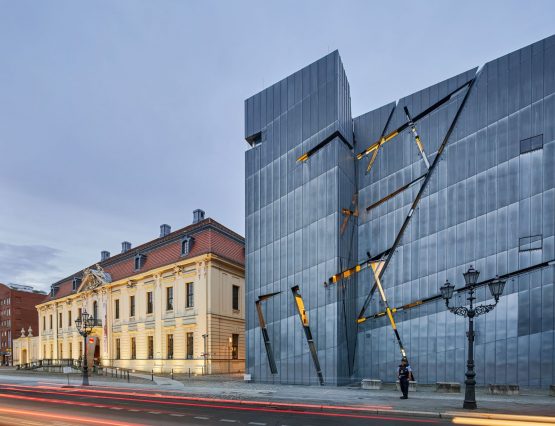
The Jewish Museum Berlin, which opened to the public in 2001, exhibits the social, political and cultural history of the Jews in Germany from the fourth century to the present, explicitly presenting and integrating, for the first time in postwar Germany, the repercussions of the Holocaust. The new building is housed next to the site of the original Prussian Court of Justice building which was completed in 1735 now serves as the entrance to the new building.
Daniel Libeskind’s design, which was created a year before the Berlin Wall came down, was based on three insights: it is impossible to understand the history of Berlin without understanding the enormous contributions made by its Jewish citizens; the meaning of the Holocaust must be integrated into the consciousness and memory of the city of Berlin; and, finally, for its future, the City of Berlin and the country of Germany must acknowledge the erasure of Jewish life in its history.
The visitor enters the Baroque Kollegienhaus and then descends by stairway through the dramatic Entry Void, into the underground. The existing building is tied to the new extension, through the underground, thus preserving the contradictory autonomy of both the old and new structures on the surface. The descent leads to three underground axial routes, each of which tells a different story. The first leads to a dead end – the Holocaust Tower. The second leads out of the building and into the Garden of Exile and Emigration, remembering those who were forced to leave Berlin The third and longest, traces a path leading to the Stair of Continuity, then up to the exhibition spaces of the museum, emphasizing the continuum of history.
A Void cuts through the zigzagging plan of the new building and creates a space that embodies absence. It is a straight line whose impenetrability becomes the central focus around which exhibitions are organized. In order to move from one side of the museum to the other, visitors must cross one of the 60 bridges that open onto this void.
AWARDS
2010 – Buber-Rosenzweig Medal from DKR (German Coordinating Council of Societies for Christian-Jewish Cooperation)
1999 – The German Architecture Prize
1998 – The Best of 1998 – Art forum International
More about this project
World Trade Center Master Plan
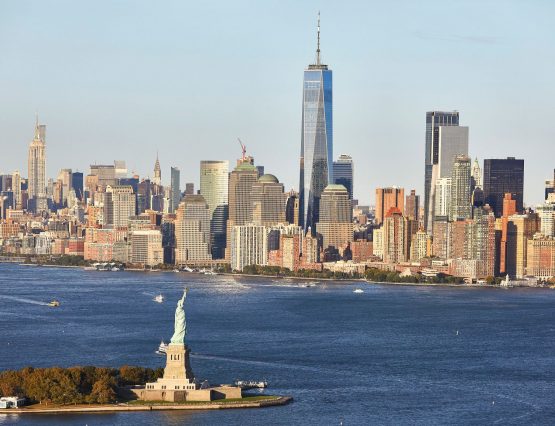
In 2002, the Lower Manhattan Development Corporation (LMDC) launched an international competition to redevelop the 16 acres in Lower Manhattan devastated by the terrorist attacks of September 11. Studio Libeskind’s proposal, Memory Foundations, was selected as the winning master plan.
In developing the design, Daniel Libeskind worked closely with stakeholders, survivors, and the public—recognizing that the challenge was not simply architectural but deeply human. The plan sought to balance remembrance with renewal, preserving the memory of the tragedy while restoring vitality to one of New York’s most significant neighborhoods.
At the heart of the concept is openness, light, and memory. The center of the site remains unbuilt—a space of illumination and reflection that anchors the entire plan. Water was incorporated into the memorial to create a contemplative atmosphere, softening the sounds of the city and preserving the original footprints of the Twin Towers as sacred voids.
Surrounding towers were positioned along the site’s perimeter, their footprints minimized to reduce shadows and maintain sunlight across the plaza. This configuration established an open, luminous landscape where visitors navigate by light rather than walls. The towers rise in a spiral within the restored street grid, culminating in One World Trade Center—a 1,776-foot-high symbol of freedom that recalls the year of American independence and echoes the torch of the Statue of Liberty.
A defining feature of the plan is the “wedge of light” on the eastern edge of the site, carefully aligned so that each September 11, sunlight illuminates the memorial plaza between 8:46 a.m. and 10:28 a.m.—the precise times when the Twin Towers were struck and fell. This celestial alignment transforms the site into a living monument: a calendar of light, a civic axis of remembrance, and a beacon of renewal.
The plan also called for the exposure and preservation of the original slurry wall—the massive retaining structure that held back the waters of the Hudson River. Incorporated into the 9/11 Memorial Museum and the PATH station, it stands as a powerful symbol of endurance and the human spirit, grounding the project both literally and emotionally in the city’s bedrock.
More than a master plan, Memory Foundations represents an act of collective remembrance—an urban framework where the rebirth of Lower Manhattan is guided not only by architecture, but by light, time, and the enduring presence of memory itself.
AWARDS
2018 – CTBUH Urban Habitat Award
2012 – AIA National Service Medal
2004 – Best of New York Award, for the ‘Building of New York’, Hosted by the New York City College of Technology Foundation, New York, USA
Sekyra Flowers
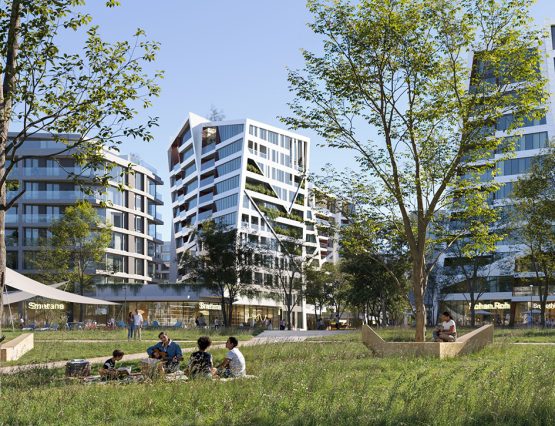
Sekyra Flowers, designed by Studio Libeskind in collaboration MS Architekti (Prague) and with developed by Sekyra Group, will be the centerpiece of Rohan City—Prague’s bold new urban district on the banks of the Vltava River.
This landmark project features four sculptural residential towers offering around 500 apartments, framed by a vibrant new public square dedicated to philosopher Simone Weil. Inspired by blossoms in bloom, each tower rises in shimmering metallic segments with green roofs and terraces that blend city living with nature. At street level, cafés, shops, and leisure venues will bring life to the pedestrian pathways, connecting seamlessly to bike trails and park spaces.Transforming a 21-hectare brownfield site, Rohan City is envisioned as Prague’s new green heart, where nearly half the area is devoted to parks and public spaces.
In keeping with its cultural mission, Rohan City will feature streets, parks, and squares named after prominent Czech and international philosophers, making it the first “Neighbourhood of Philosophers” in Europe. Plans also include a National Centre for Reading Culture, envisioned as part of Libeskind’s master plan.
When completed by 2035, Rohan City will provide homes and workplaces for 11,000 people, representing an investment of over 30 billion CZK—a vibrant new symbol of modern Prague.
More about this projectSamsung Daechi Ssangyong 1 Redevelopment
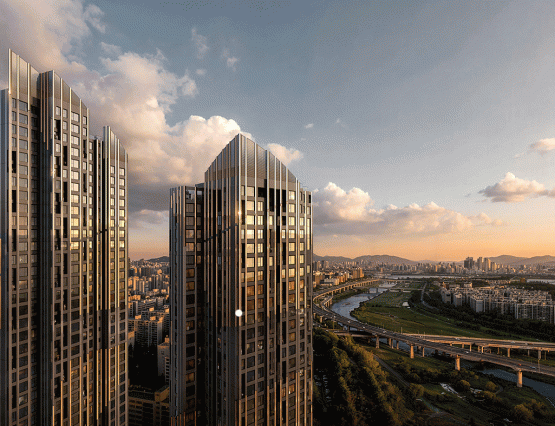
The Samsung Daechi Ssangyong 1 Redevelopment reimagines an aging residential complex in Seoul’s Gangnam district as a vibrant new neighborhood of six residential towers, generous public space, and landscape-integrated amenities. Replacing 630 existing residences with nearly one thousand homes, the project creates a new model for urban living rooted in community, nature, and sustainability.
Inspired by the concept of Celestial, the sculptural towers appear to rotate and ascend, their faceted façades changing with light and perspective while integrating building-integrated photovoltaic panels. A ribbon-like observation lounge overlooking Yangjae Stream extends into a network of terraced gardens and public spaces, connecting architecture with the surrounding landscape.
Carefully oriented to maximize daylight and views, the master plan includes a central plaza, elevated community spaces, and shared amenities that foster connection while creating a rich and dynamic living environment. The project is slated to begin in 2027
More about this projectFan d’Issy Mixed-Use

Studio Libeskind, in collaboration with La Compagnie de Phalsbourg, is designing the flagship building for the Léon Blum district, adjacent to the future Line 15 of the Grand Paris Express. Issy-les-Moulineaux is transforming remarkably, positioning itself at the forefront of urban development. Central to this change is Issy station, which will soon be connected to the Grand Paris Express, catalyzing growth. This significant infrastructure project aims to enhance mobility for residents and workers, reflecting the City’s commitment to ambitious and sustainable urban planning.
The project features a mixed-use program covering more than 20,000 square meters, including a hotel, retail, office, and residential, a third of which will be social housing. Fan d’Issy will have a geometric shape with expansive green walls and slanted facade elements that appear to fan out. It was designed to be a landmark building in the ZAC Léon Blum eco-district, which is currently under development. Construction on the building will commence after the completion of the adjacent Issy station, which will serve the new Line 15 of the Grand Paris Express metro.
More about this projectRAI TV Daniel Libeskind at the Jewish Museum Berlin
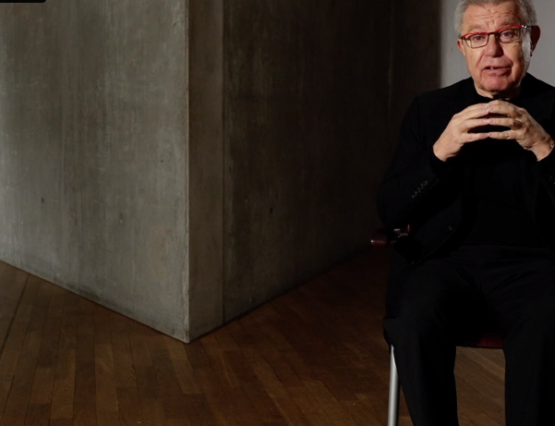
Daniel Libeskind is interviewed in the Jewish Museum Berlin for Holocaust Remembrance Day. Film by Antonello Savoca/ Rai
More about this articleA short film on the Dutch Holocaust Memorial of Names
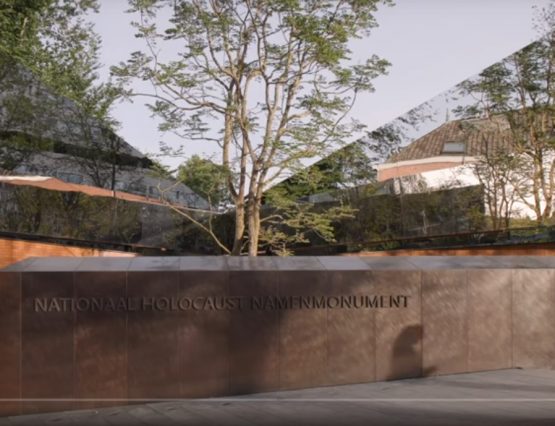
A video tour through the Dutch Holocaust Memorial of Names
More about this articleDreams of Freedom. Romanticism in Germany and Russia
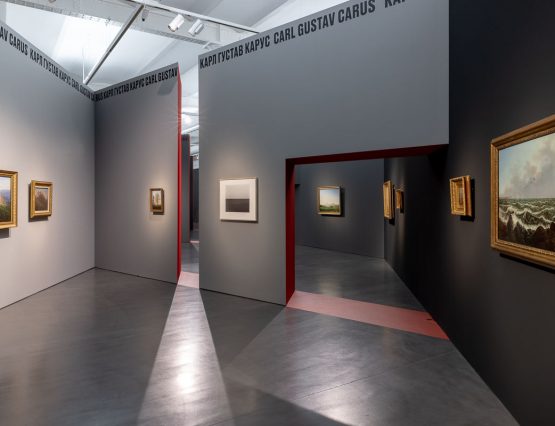
Studio Libeskind was engaged by the organizers to create an exhibition design for the exhibition “Dreams of Freedom. Romanticism in Germany and Russia” that will be at the Tretyakoy Gallery in Moscow and the … in Dresden, Germany, respectively. The design by Architect Daniel Libeskind is a response to the masterpieces of works by the greatest artists of the first quarter of the 19th century: Caspar David Friedrich, Philipp Otto Runge, Johann Overbeck, Alexander Ivanov, Alexei Venetsianov, Orest Kiprensky, Karl Bryullov and others. A key idea was to create a space that will give a visceral sense of the Romantic artists and their quests through the way a visitor moves through the space.
As visitors enter the galleries, they embark on a journey through two interlaced spirals that create a series of oblique and intimate gallery spaces within the labyrinth. Libeskind envisioned an imaginary line between Dresden and Moscow to create a coordinated system of axes that gives the visitor a compass to orient themselves between the two cities—as well as between two analogous states of mind. The visitor has both clarity and uncertainty in navigating the exhibits, echoing the power and dynamism of Romanticism. Red passageways, black and grey blocks of color, and bold graphic lettering on the walls create a dramatic series of gallery spaces that guide and inform the visitor through the exhibition.
Visitors will encounter more than 350 works of art, including approximately 200 paintings, supplemented by archival materials and unique exhibits from dozens of German and Russian collections.
The exposition was developed by experts from the Tretyakov Gallery and Dresden museums and will be displayed in two installations, one in Moscow and the other in Dresden.
Tretyakov Gallery in Moscow, Russia: April 23, 2021 to August 8, 2021
Albertium at the SK Museum in Dresden, Germany: October 2, 2021 to February 6, 2022
Studio Weil: A Discussion on Design Inspiration
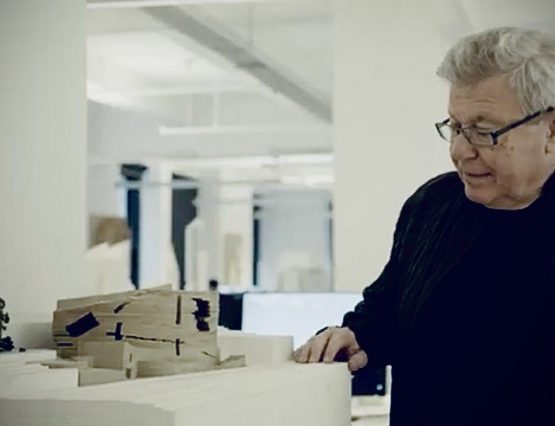
Architect Daniel Libeskind talks about his design for the Studio Weil building in Mallorca, Spain. The project was completed in 2003.
See more here: Studio Weil
Forever Marked by the Day, Muscarelle Musuem of Art
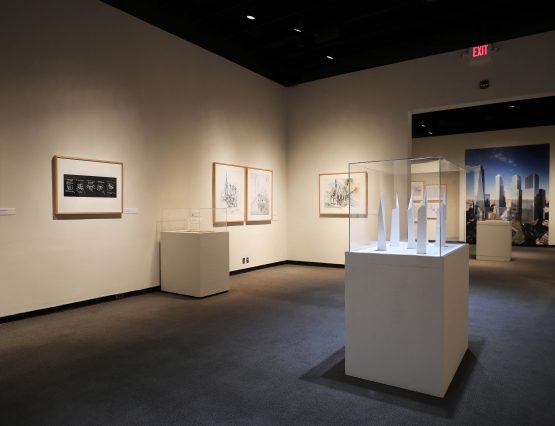
The new World Trade Center is a space of remembering and healing, as well as a tribute to life and art. This place serves as a memorial designed to honor people and commemorate heroes and connects the past and the future to the present through architecture. The buildings and spaces designed by Daniel Libeskind, Michael Arad, David Childs, and Santiago Calatrava function as channels to find new purpose and peace after the attacks on September 11, 2001. Forever Marked by the Day pays homage to those architects, artists, designers, and photographers who made creativity triumph over destruction.
Daniel Libeskind Tries His Hand at Affordable Housing

Architecture critic Justin Davidson reviews the affordable housing project, The Atrium in Bedford-Stuyvesant, for New York Magazine’s Curbed.
“With the Atrium, Libeskind has given vulnerable people a place they can gradually make their own. He has also demonstrated that the daunting list of rules, requirements, prohibitions, and economic strictures that govern affordable housing in New York don’t have to choke off inventive architecture. The firms with experience negotiating those constraints don’t generally indulge in innovation, and those that prize capital-A Architecture avoid the long and frustrating gauntlet of New York’s housing bureaucracy. Getting this project finished — assembling the team, winning the job, completing the design, gathering the funding, and finally putting up the building — took seven years.”
More about this article
BBC Radio: In the Studio

Daniel Libeskind is one of the world’s leading architects. Amongst his many projects, he devised the masterplan for the re-development of Ground Zero in New York and designed the Jewish Museum in Berlin. He tells Samira Ahmed about the Albert Einstein House in Jerusalem, a new building which will house Einstein’s work and belongings, from his favourite novels, his letters as a peace campaigner, to his papers laying out his famous theory of relativity. He also talks Samira through the many other global projects he’s working on, including a museum of anthropology in Iquique, Chile.
Producer: Olivia Skinner
More about this articleArchitectural Digest: Is Daniel Libeskind’s Latest Residential Building a Blueprint for Affordable Housing?

A twisting façade of geometric windows and sharp angles emerges like a beacon in Bed-Stuy, Brooklyn. Located on the campus of New York City Housing Authority’s (NYCHA) Sumner Houses, a 1958 affordable residential development, the building is a bright spot among the unadorned redbrick towers surrounding it. Sumner House Atrium, as it’s called, was designed by Daniel Libeskind and is the new blueprint for affordable housing in New York City.
Studio Libeskind’s sculptural Maggie’s Centre at Royal Free Hospital opens its doors in London
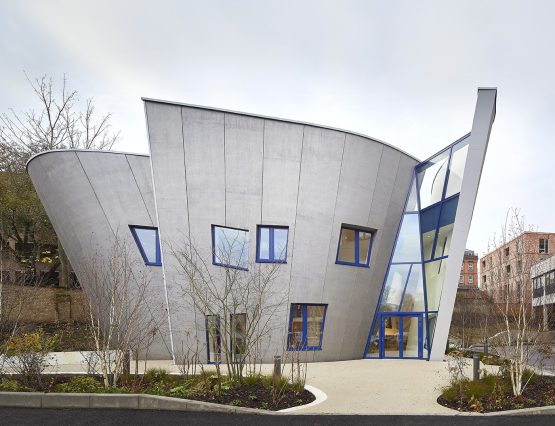
When the architect Charles Jencks’s wife, Maggie, was diagnosed with cancer, he wanted to channel his grief towards something productive that helped others with similar diagnoses. Shortly after, Jencks co-founded a charity, Maggie’s Centre, which sought to provide thoughtful healthcare architecture for cancer patients around the world. Since 1995, luminaries like Zaha Hadid, Steven Holl, Kisho Kurokawa, Richard Rogers, Frank Gehry and others have designed compact treatment facilities for the nonprofit.
More about this articleThe Danish Jewish Museum gets a new, intersectant entrance by Daniel Libeskind
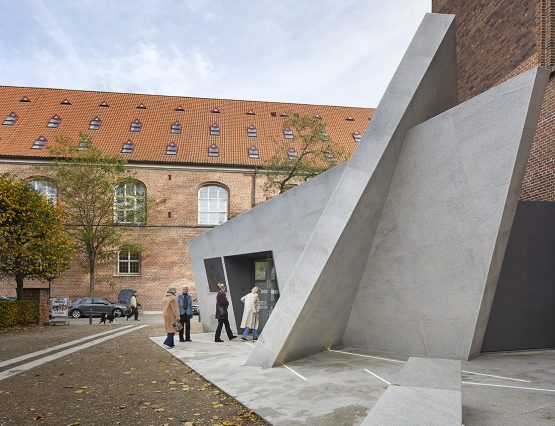
The architecture of entrances rightly empowers the building they perform as portals to—ranging from ornate cathedral doors with gold inlays to a hole in the wall, entrances mark a threshold into spaces and ensuing behaviors. This is an architectural element of visual conjuncture that is perhaps inadvertently overlooked, despite carrying a substantial purpose of shifting perspectives, greeting and welcoming, embodying security, and at the onset, setting a structure’s first impression.
More about this articleDaniel Libeskind
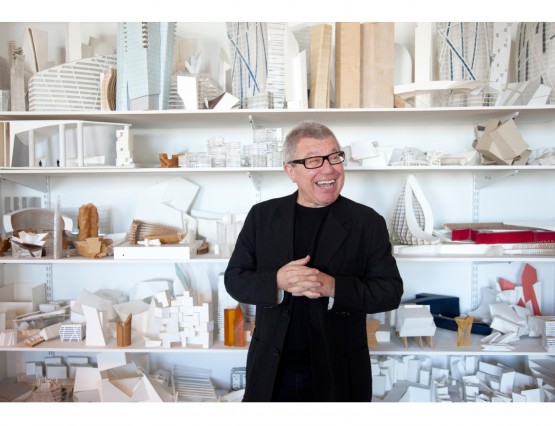
An international figure in architecture and urban design, Daniel Libeskind is renowned for his ability to evoke cultural memory through architecture. Informed by a lifelong engagement with music, philosophy, literature, and poetry, his work seeks to create buildings that are emotionally resonant, intellectually rigorous, and deeply sustainable.
Born in Łódź, Poland, in 1946, Libeskind immigrated to the United States as a teenager, settling with his family in the Bronx. A gifted musician, he received a scholarship from the American-Israel Cultural Foundation and performed as a virtuoso before turning to architecture. He earned his professional degree from The Cooper Union for the Advancement of Science and Art in 1970, followed by a postgraduate degree in the history and theory of architecture from the University of Essex in 1972.
In 1989, Libeskind won the international competition to design the Jewish Museum Berlin, a project that established him as a major voice in contemporary architecture. Relocating with his young family to Berlin, he devoted more than a decade to its realization. This seminal work was followed by a series of influential cultural commissions, including the Felix Nussbaum Haus in Osnabrück; Imperial War Museum North in Manchester; Denver Art Museum; Contemporary Jewish Museum in San Francisco; Danish Jewish Museum in Copenhagen; Royal Ontario Museum in Toronto; and the Military History Museum in Dresden.
In 2003, Studio Libeskind won another historic competition: the master plan for the redevelopment of the World Trade Center in Lower Manhattan. The design reimagined the sixteen-acre site as a place of both remembrance and renewal, integrating the memorial, museum, restored street grid, transportation hub, and a dynamic commercial district anchored by a symbolic 1,776-foot tower.
Following his move to New York, Libeskind expanded the studio’s global portfolio to include major commercial and residential projects, such as Westside in Bern, Crystals at CityCenter in Las Vegas, and Kö-Bogen in Düsseldorf, as well as residential towers in cities including Busan, Singapore, Warsaw, Toronto, Manila, and São Paulo.
Studio Libeskind operates as an internationally active architecture and urban design practice headquartered in New York, working through a global network of consultants and collaborators. The firm’s multidisciplinary team includes architects, urban designers, sustainability specialists, and project managers experienced in delivering complex projects across diverse regulatory and cultural contexts. Intentionally kept small—approximately fifty full-time professionals in the New York studio—the practice maintains a high level of design control and close principal involvement, focusing its energy on a select number of projects it is deeply committed to.
The studio’s work spans North and South America, Europe, Asia, Australia, and the Middle East, encompassing both major global cities and regional contexts. This breadth of experience allows Studio Libeskind to bring a global perspective alongside a strong sensitivity to local culture, history, and environment in every commission.
As Principal Design Architect of Studio Libeskind, Libeskind lectures widely at universities and international forums. His work has been the subject of numerous exhibitions and publications, shaping discourse on architecture, memory, and the contemporary city. He has received many prestigious honors, including the Goethe Medal, the Hiroshima Art Prize, the Dresden Peace Prize, and the European Union Prize for Civil Rights. He has also been appointed a Knight of the Order of Arts and Letters by the French Republic.
Libeskind lives in New York with his wife and business partner, Nina Libeskind, and is a licensed architect in the State of New York.
Nina Libeskind

Nina Libeskind oversees the strategic and operational management of Studio Libeskind, guiding all aspects of the practice from financial planning and governance to day-to-day administration and human resources. She plays a central role in shaping the studio’s business operations, providing counsel across project development, contracts, and long-term planning, while also participating in public presentations, client engagement, and communications.
A co-founder of Studio Libeskind in 1989, Nina has been instrumental in building the practice into an internationally recognized architecture and urban design firm. She brings a broad range of experience in labor negotiations, public policy, and political advocacy across the United States, Canada, and Great Britain—expertise that continues to inform the studio’s collaborative approach and its ability to navigate complex institutional and civic projects.
Through her leadership, Nina ensures that the studio operates with both rigor and agility, supporting its global work while maintaining a close-knit, values-driven culture.
Carla Swickerath

Since joining Studio Libeskind in 1999, Carla Swickerath has developed broad international experience across cultural, civic, retail, commercial, residential, and master planning projects. Over more than two decades with the firm, she has led many of the studio’s most significant commissions from concept design through completion, including the Crystals retail complex at CityCenter in Las Vegas, the Hyundai Haeundae Udong I-Park residential development in Busan, South Korea, and the Contemporary Jewish Museum in San Francisco.
Ms. Swickerath has also played a leading role in the complex redevelopment of the World Trade Center site, guiding the project from the initial competition phase through its ongoing realization. Her ability to manage large-scale, multi-stakeholder projects has been central to advancing one of the most significant urban developments of our time.
Today, she brings together design leadership and operational oversight as she oversees all aspects of Studio Libeskind’s operations. She leads many of the studio’s projects globally, coordinating multidisciplinary design teams and consultants, liaising closely with clients and their representatives, and managing project budgets, schedules, and delivery. Her dual expertise in design and management ensures both creative rigor and effective execution.
Ms. Swickerath holds a Master of Architecture from the University of Michigan and a Bachelor’s degree in English and Art History from the University of Florida. She has taught at the Kunsthochschule Berlin-Weißensee in Berlin and at the University of Michigan, and regularly speaks publicly on architecture, urban design, and planning.
Stefan Blach
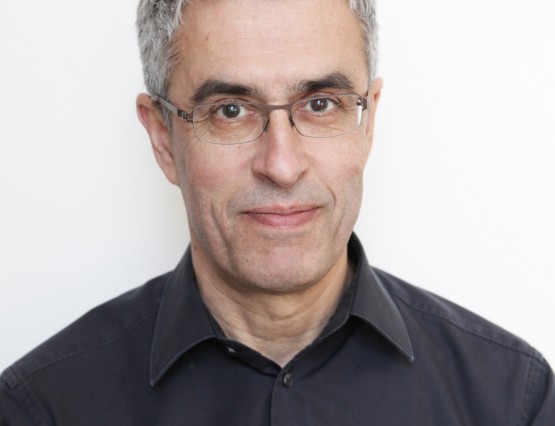
Stefan Blach brings more than two decades of experience leading some of Studio Libeskind’s most complex, large-scale projects worldwide. He has directed multidisciplinary design and consultant teams across a wide range of cultural, residential, and commercial developments, guiding projects from concept through completion. His work includes the realization of the Jewish Museum Berlin; the urban regeneration of the Bord Gáis Energy Theatre and Grand Canal Commercial Development in Dublin; the LEED Platinum–certified Kö-Bogen retail and office complex in Düsseldorf; and the award-winning MO Museum in Vilnius.
Stefan approaches each project with a focus on understanding the specific complexities of program and site, developing creative yet practical solutions that deliver design excellence while meeting budget and schedule requirements. His leadership is defined by a clear, strategic approach that balances innovation with constructability.
He is currently overseeing several major international projects, including the Museo Regional de Tarapacá in Chile, a residential development in Frankfurt, and the Central Deck and Arena mixed-use development in Tampere, Finland, alongside ongoing commercial and cultural commissions across Europe and Asia.
Prior to joining Studio Libeskind, Stefan worked independently with renowned architects including Tim Heide in Berlin and Salvador Pérez Arroyo in Madrid, contributing to projects such as the Museo de la Ciencia in Cuenca. He received his Diploma in Architecture from the Technische Universität Berlin in 1991. Stefan is fluent in German and English and is proficient in Spanish.
Michael Ashley
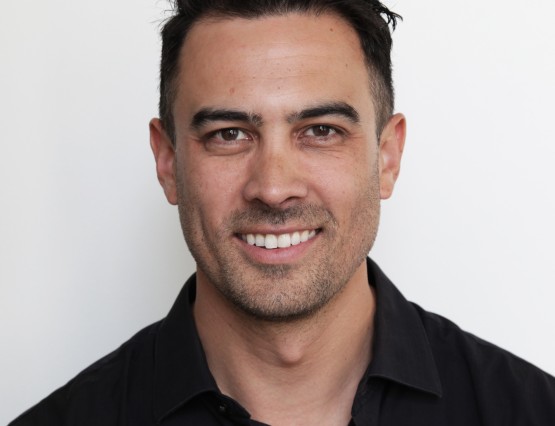
Michael Ashley, RA, serves as Principal at Studio Libeskind, leading a wide range of projects spanning cultural, residential, and commercial developments worldwide. He plays a central role in shaping architectural concepts and guiding projects from early design through development, translating complex narratives, sites, and programmatic ambitions into distinctive and meaningful architecture.
Mr. Ashley has led and contributed to a number of significant international projects, including Maggie’s Centre in London and the National Holocaust Monument in Ottawa. He is currently leading the transformation of the Boerentoren in Antwerp—Europe’s first skyscraper—into a major new cultural institution. He was also a key member of the design team for the Zhang Zhidong Museum, which opened in 2018; the CityLife PwC Tower in Milan; and major mixed-use developments in France, including the Occitanie Tower in Toulouse and Iconic in Nice, as well as the reimagined Tree of Life project in Pittsburgh.
Prior to joining Studio Libeskind, Michael gained experience at a number of multidisciplinary practices, including LPAS in Sacramento and Mark Dziewulski Architects in San Francisco, where he specialized in mixed-use and residential projects. He also led his own studio, developing work across architecture, product design, and furniture.
Mr. Ashley holds a Master of Science in Advanced Architectural Design from Columbia University and a Bachelor of Architecture from Andrews University. He has served as a visiting critic at Columbia University, Pratt Institute, Parsons School of Design, and the New York Institute of Technology, and regularly speaks on architecture and design, including engagements at the United Nations International School.